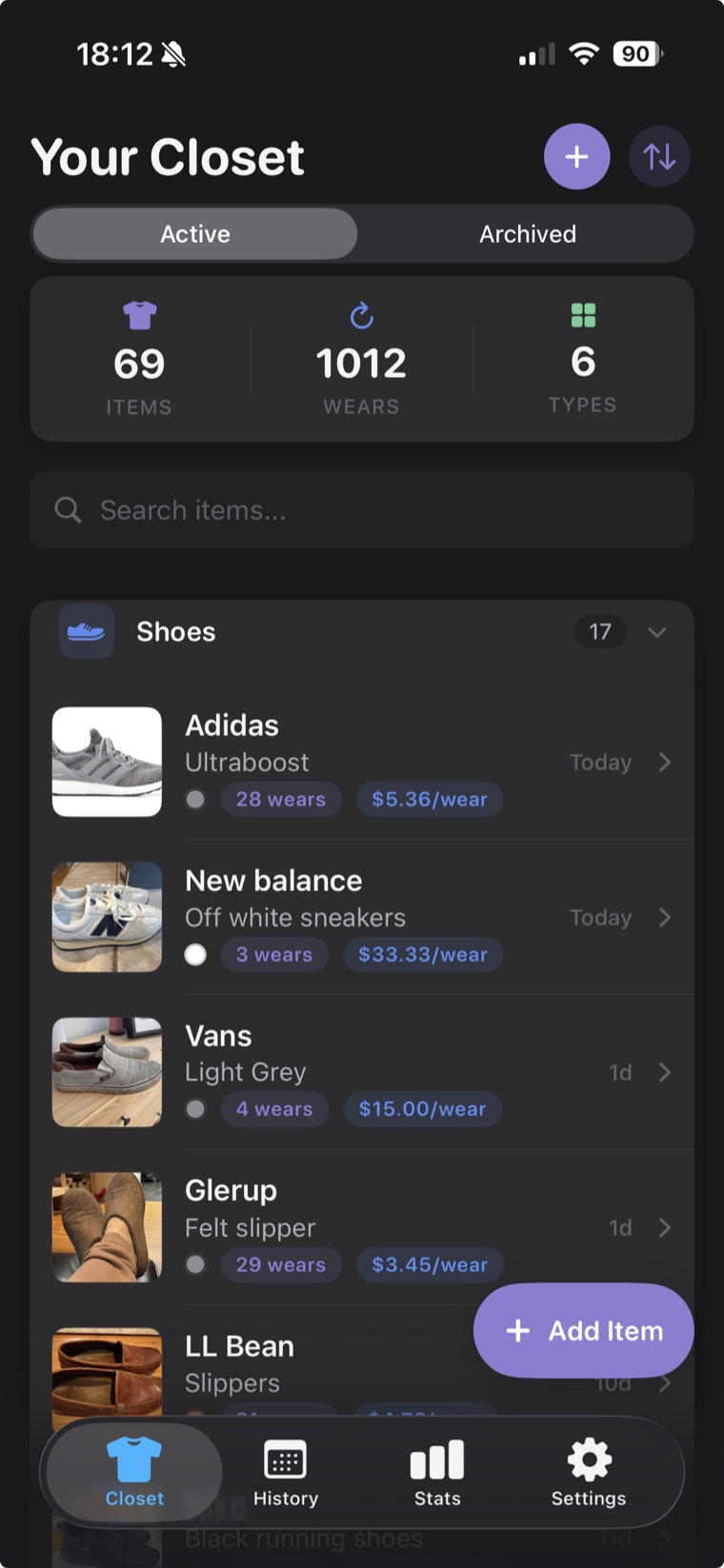
What is cost per wear?
Cost per wear is one of the most useful ideas in fashion, and one of the simplest. It's the price of a piece of clothing divided by the number of times you wear it — the true cost of owning something, spread across every time you actually use it.
It quietly changes how you shop, what you keep, and how you feel about the clothes already hanging in your closet. Here's how it works, what counts as a good cost per wear, and how to bring yours down.
What cost per wear actually means
Put simply: cost per wear is what an item costs you each time you put it on. A $200 coat worn 100 times costs $2 per wear. The same coat worn twice costs $100 per wear. Same price tag — wildly different value.
That's the whole point. The sticker price tells you what something costs to buy. Cost per wear tells you what it costs to own and use — which is the number that actually matters once it's in your wardrobe.
The cost per wear formula
So for a jacket you bought for $180, paid $20 to tailor, and have worn 50 times:
($180 + $20) ÷ 50 = $4.00 per wear — and it keeps falling every time you wear it again.
A quick example: the "expensive" coat is often the bargain
Imagine two coats:
- A $90 fast-fashion coat that pills and sags after one season. You wear it 6 times before giving up on it. That's $15 per wear.
- A $300 wool coat you reach for all winter, four years running — roughly 120 wears. That's $2.50 per wear.
The coat that looked three times more expensive turned out to cost six times less to own. Cost per wear is what makes that obvious. It rewards buying things you'll actually reach for, and wearing them for years.
Why cost per wear matters
Most of us judge clothes at the till, by the price tag. But the real waste isn't the expensive thing you wear constantly — it's the cheap thing you wore once and forgot. A garment worn a single time absorbs its full price in that one moment. A garment worn week after week spreads its cost across months and years until it's practically free.
That reframe is why cost per wear is the favourite metric of the "buy less, wear more" and #30wears movements. It turns guilt about a splurge into a reason to wear it. It makes the forgotten pieces at the back of your closet impossible to ignore. And it's a quietly powerful nudge toward a smaller, more sustainable wardrobe — not by buying nothing, but by getting more out of what you already own.
What is a good cost per wear?
There's no single magic number — it depends on the type of item and how long it lasts. As a rough guide, here's what tends to count as good value once a piece is broken in:
| Type of item | "Good" cost per wear |
|---|---|
| Basics — tees, socks, underwear | under $1 |
| Everyday — jeans, tops, knitwear | $1–3 |
| Shoes, boots & bags | $2–5 |
| Coats, jackets & blazers | $3–8 |
| Suits & occasion wear | $5–15+ |
Treat these as a compass, not a rule. A $1,000 coat at $10 per wear can be a smarter buy than a $20 top you wear once at $20 per wear. The goal isn't to hit a number — it's to wear what you own more, and to buy the next thing a little more carefully.
How to lower your cost per wear
- Wear it more. Obvious, but it's by far the biggest lever. Every extra wear divides the price further. The #30wears pledge — committing to wear something at least 30 times — is built entirely on this idea.
- Buy things you'll actually reach for. Versatile, comfortable pieces that fit your real life get worn; "aspirational" buys that don't suit your routine sit unworn at $∞ per wear.
- Buy quality that lasts. A higher price can mean a far lower cost per wear if the item survives hundreds of wears instead of falling apart in a season.
- Look after it. Repairs, resoling, and tailoring extend an item's life and keep it in rotation — and you simply add those costs into the formula.
- Rediscover what you already own. The forgotten pieces in the back of your closet are sunk cost. Wearing them again is the cheapest "new outfit" there is — it lowers their cost per wear for free.
The catch: you have to know your real number
Here's the honest limitation of cost per wear. The math only works if you know how many times you've actually worn something — and almost nobody does. We overestimate the things we love and forget the things we don't. A calculator can give you a hypothetical ("if I wear this 50 times…"), but the real cost per wear changes every single time you get dressed.
The only way to get the true number is to track it.
WearTracker turns cost per wear from a guess into a real, live number. Log what you wore in one tap and it keeps the true cost per wear for every item you own up to date — plus wardrobe stats and the pieces you've quietly stopped wearing.
Know your real cost per wear
Free on iPhone · 4.4★ from 93 ratings · no account needed
Download on theApp StoreCost per wear, in one line
Divide what you paid by how many times you wear it. Buy things you'll wear often, wear them for years, and the price stops mattering — because almost everything good gets cheaper the more you use it.